5 Simple and Most Popular Money Management Rules
The Money Management rules are sometimes presented with quite complex details, making them difficult to approach for many new traders. Below are 5 simple and most popular Money Management rules in the trading community, aimed at helping you apply them more easily in practice.
Money Management is one of the most important aspects of Forex trading, yet it is often overlooked. Many traders often misunderstand or incorrectly apply the various Money Management rules. When trading failures occur, the strategy is often blamed, and traders in general tend to focus more on finding a "holy grail" trading system (i.e., searching for a perfect trading strategy) rather than building an effective Money Management plan. However, this is also understandable, as the details in the Money Management rules can sometimes be quite confusing and difficult for newcomers to grasp. To help you organize and better understand your own Money Management, here are 5 simple and most common Money Management rules in the trading community.

1. The 1% Rule
The Money Management rule known as the 1% Rule states that you should not risk more than 1% of your equity (actual capital in your account) on a single trade. For example, if you are trading with a capital of 1,000 USD, then according to the 1% Rule, you should not risk more than 10 USD on each trade.
At first glance, this may seem simple, but applying it in practice is not easy at all. For instance, with that capital (1,000 USD) when you trade with a mini lot (0.1 lot), the stop loss must be set about 10 pips away from the entry position. This is a very tight stop loss, isn't it? And with such a narrow stop loss, it is like inviting losses. However, conversely, if you use a micro lot (0.01 lot), the stop loss can be set about 100 pips away from the entry position, and this stop loss is wider and more suitable for the natural market volatility.
From the above example, it can be seen that Money Management rules are not only related to how much capital is used, but also to how large the lot size is and where the stop loss is placed each time a position is opened.
There are some variations of the 1% Rule. Traders with larger capital can apply the 1% rule on their total capital, rather than on each individual order. This means that regardless of how many trades are opened at the same time, the total amount at risk should not exceed 1% of the capital. Some traders also adjust this ratio to 2%, 5%, and other levels, depending on their capital scale and the level of risk they are willing to accept. However, for newcomers, the 1% level is often considered the safest and most sustainable.
2. Risk/Reward Ratio
The concept of Money Management is often considered most ideal when applying the risk/reward ratio, especially the 1:2 ratio. This Money Management rule means that if you are willing to risk 10 USD, then under the best conditions, you can make a profit of 20 USD if the trade is successful.
Below is an example of applying Money Management by using a 1:2 risk/reward ratio through the use of Stop Loss and Take Profit features.
Suppose you open a buy position on GBP/USD at 1.3000. Then you set the Stop Loss and Take Profit levels as follows:
- Stop Loss (Risk): 1.2900, which is 100 pips below the entry price.
- Take Profit (Reward): 1.3200, which is 200 pips above the entry price.
- Risk:Reward ratio = 1:2.
Suppose you trade EUR/USD with a micro lot, which is 0.01 standard lot, at that time the value of each pip is 0.1 USD.
- If the price hits the Stop Loss and incurs a loss:
Risk = 100 pips x 0.1 USD/pip = loss of 10 USD.- If the price hits the Take Profit and generates a profit:
Profit = 200 pips x 0.1 USD/pip = profit of 20 USD.
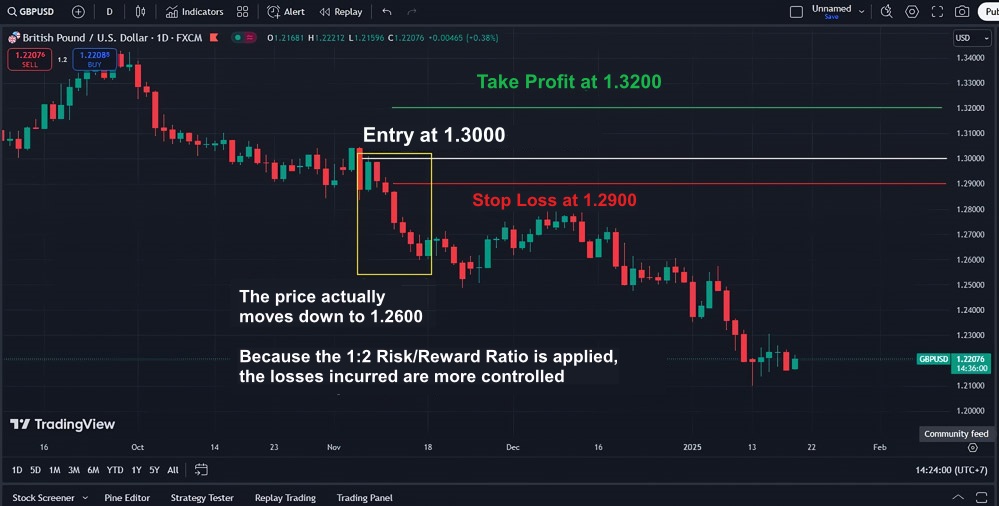
With a 1:2 risk/reward ratio, each profitable trade can cover a previous losing trade while still generating a net profit. With this approach, losses can be gradually covered, and profits can be accumulated, as long as the win rate of the trading system used reaches at least around 60%.
3. Using High Leverage
This Money Management rule will benefit traders with very small capital, but in practice, it can be quite controversial. Generally, traders with larger capital tend to use low leverage, mostly only at levels of several tens (e.g., 1:20, 1:30). However, traders with small capital, especially those under 10,000 USD, often use leverage of 1:100 or higher to open positions with larger volumes in order to seek profits. To meet this demand, many brokers offer leverage options up to 1:1000.
The advantage for traders using high leverage is very clear. The higher the leverage, the lower the margin or equity requirement, allowing traders to open larger positions with the same amount of capital. This gives the account more safety margins to withstand floating positions, thereby reducing the risk of encountering a margin call in the short term. However, on the flip side, excessive leverage can lead traders to misjudge the actual market risk. Profits may seem large but are relatively small when considering the risk ratio. Meanwhile, initial losses may seem small but can accumulate over time if traders do not manage their trade volume and risk levels on each order well.
4. Trading Low Spread Currency Pairs
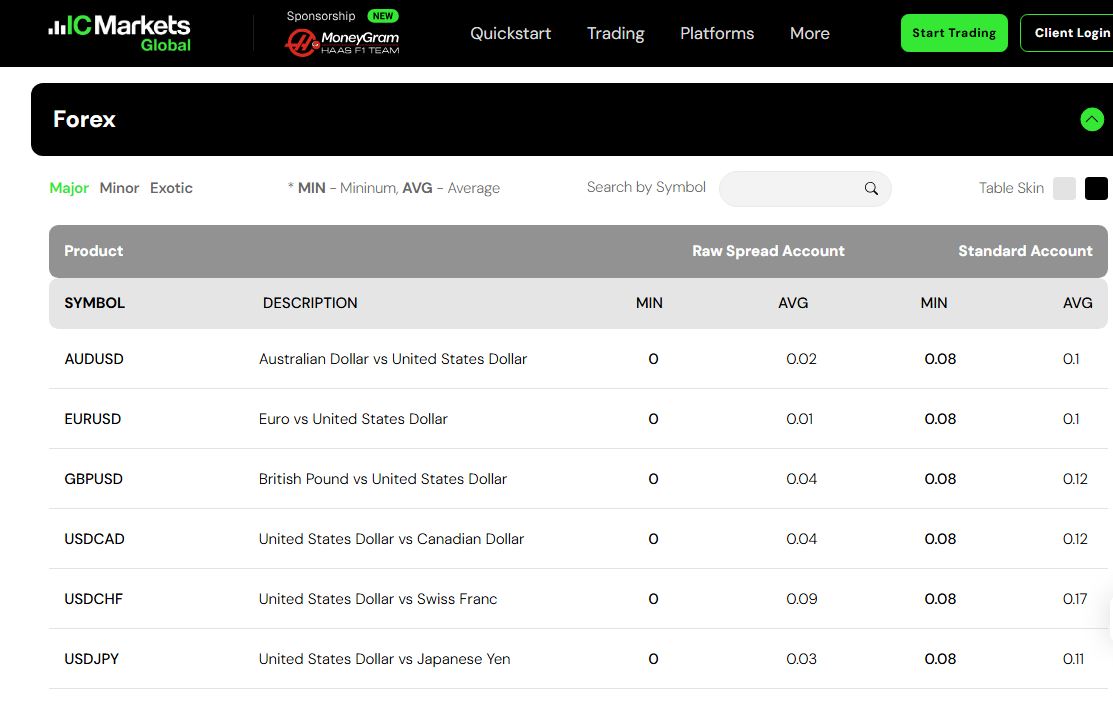
Many traders choose currency pairs to trade quite arbitrarily, without realizing that such decisions can significantly impact the Money Management being applied. For example, trading exotic currency pairs can incur spread costs of up to 50 pips or more. With such a wide spread, achieving profit targets becomes much more difficult. The solution many traders choose is to only trade the most liquid currency pairs, such as major pairs, where spreads are usually only in single digits or even below 1 pip.
Below is an example illustrating the Forex spread table provided by IC Markets, a popular broker regulated by ASIC. You can see that major pairs, as shown in the illustration below, generally have spreads below 1 pip.
5. Setting Realistic Target
This may be the simplest Money Management rule, but it is also the rule that traders often overlook the most. Due to the dream of getting rich quickly, many traders set profit targets of up to 100% in just one month. In reality, some traders may consider achieving such extraordinary profit levels, but they are often very experienced individuals trading with extremely large capital, which new traders find hard to emulate.
Greed is often the main cause of losses for traders, so be careful not to be tempted by this. Instead of setting excessively high profit targets, traders should set realistic profit goals, whether daily, weekly, or monthly.
Realistic Forex profit targets typically range from 2% to 10% per month for traders with good risk management. Depending on each trader's trading style, the following realistic profit targets can be referenced.
| Scalper |
|
| Day Trader |
|
| Swing Trader |
|
| Position Trader |
|
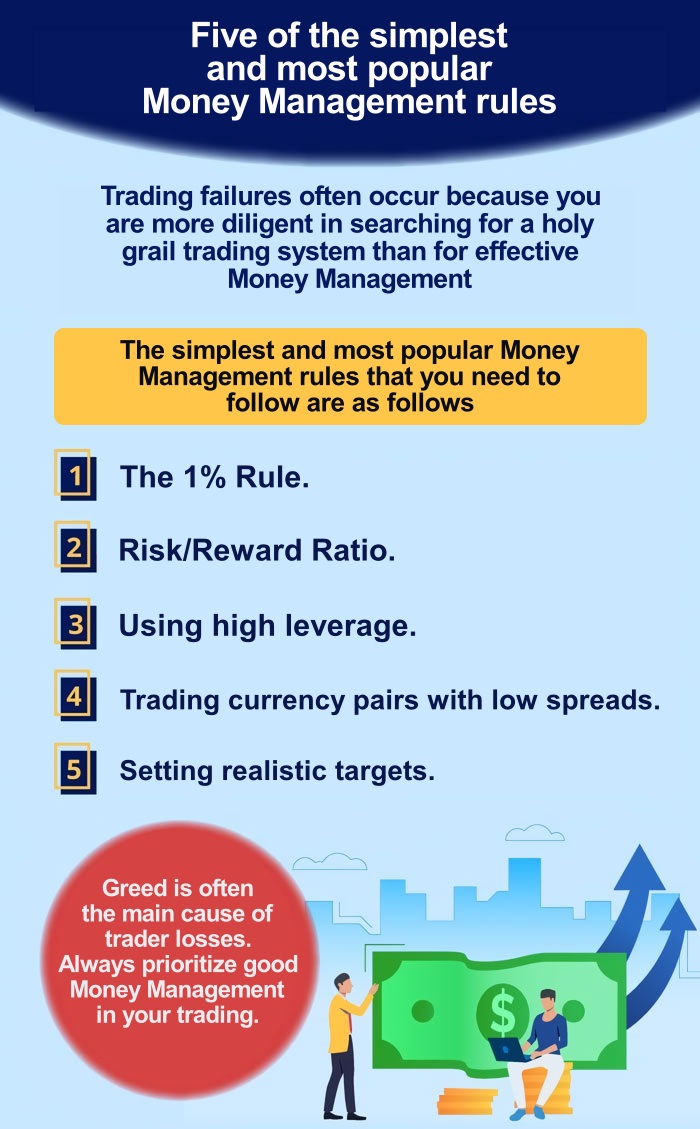
Overall, below are 5 Money Management rules presented in an infographic to help you visualise and apply them more easily.
Applying Money Management correctly can provide you with consistent trading results while controlling risk within acceptable limits. However, just having Money Management is not enough if it is not supported by building a well-structured trading plan that fits your personal trading style.