A Complete Guide to Carry Trade Strategy
At its core, the Carry Trade is a forex trading strategy that focuses on earning profits from interest rate differentials rather than from price movements.
Carry Trade works by taking advantage of the difference in interest rates between two currencies. A Carry Trader can suffer losses if the currency used for funding appreciates, if the target currency depreciates, or if both happen at the same time. Why does this occur, and how exactly does the Carry Trade strategy work? Below is a complete explanation of the Carry Trade mechanism, along with tips to help maximize profits and reduce risks when using this strategy.

How Carry Trade Works
Basically, the Carry Trade is a forex trading approach that aims to profit from interest rate differences between currency pairs, not from changes in exchange rates. In a Carry Trade, traders buy a currency with a higher interest rate while selling a currency with a lower interest rate. To optimize returns, Carry Traders usually select the currency with the highest interest rate to buy and the one with the lowest interest rate to sell within the available currency pairs.
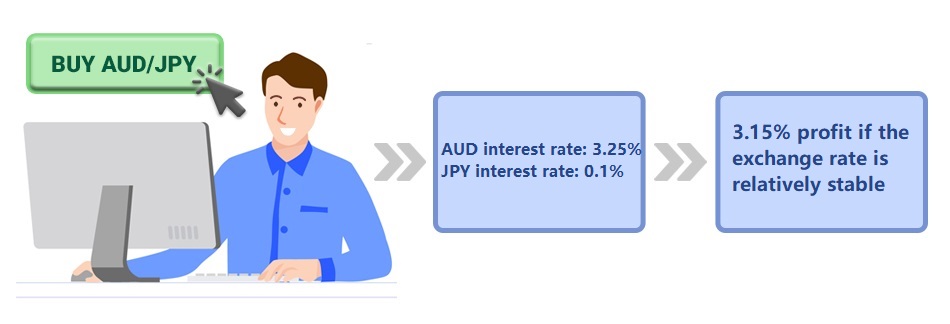
For example, if the interest rate of the Australian dollar (AUD) is 3.25% per year and the Japanese yen (JPY) is 0.1% per year, then buying the AUD/JPY pair allows traders to benefit from the interest rate differential as follows:
- By buying AUD, the trader earns an interest rate of 3.25%.
- By selling JPY, the trader pays an interest rate of 0.1%.
If the AUD/JPY exchange rate remains stable or does not fluctuate significantly, Carry Traders can earn a net profit of 3.15% per year from the interest rate difference alone. With a position size of 1 standard lot, equivalent to 100,000 AUD, the trader receives 3.15% interest annually. When using leverage of 200:1, the required margin is only 500 AUD, allowing the trader to potentially earn 3,150 AUD per year from the interest rate differential.
Suitable Currencies for Carry Trade Strategy
Not all currencies are suitable for optimal implementation of the Carry Trade strategy. Below are several key characteristics that traders should consider when selecting currency pairs.
Liquid currency pairs
Currencies commonly used in Carry Trade strategies are usually major currency pairs with high liquidity. High liquidity allows traders to enter and exit positions more easily at desired price levels. Examples of highly liquid currencies include USD, GBP, JPY, AUD, CAD, CHF, and NZD.
On the other hand, currencies from emerging markets such as Indonesia or Turkey may offer very high interest rates but tend to have low liquidity. As a result, trading activity is limited, and it can be difficult to match buy and sell orders at expected price levels.
High interest rate differentials within a currency pair
A successful Carry Trade requires two currencies with a significant interest rate difference. This was shown in the AUD/JPY example above. As interest rates change across countries, Carry Trade preferences may shift from one currency pair to another.
Several years ago, the NZD/JPY pair was a popular choice for Carry Trade strategies. Traders opened buy positions not because of expectations of strong economic growth in New Zealand, but because the NZD interest rate was around 8% while the JPY interest rate was only 0.5%. This 7.5% gap was highly attractive to fund managers, especially considering the potential for additional gains if the NZD appreciated against the yen.
However, when the New Zealand dollar interest rate declined to around 2.5% per year and the Australian central bank continued raising interest rates, Carry Traders gradually shifted their focus to the AUD/JPY pair.
Relatively stable exchange rates between currencies
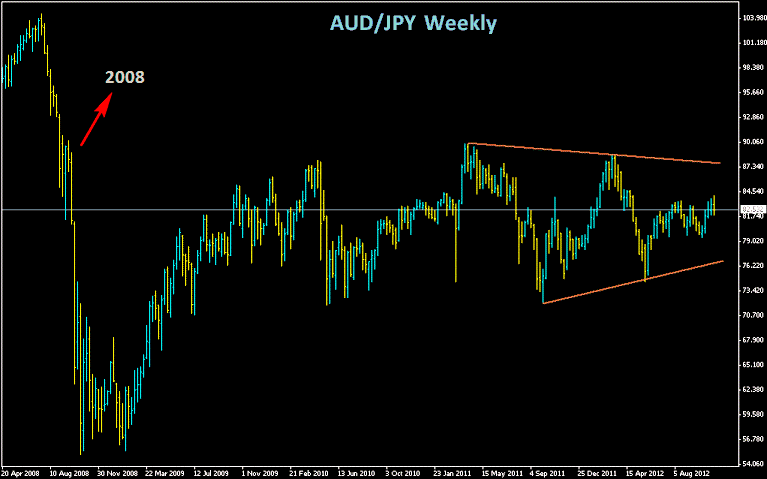
Carry Trade strategies on pairs such as NZD/JPY and AUD/JPY generated substantial profits until the global financial crisis in 2008. During that period, the Australian dollar experienced a sharp and highly volatile decline against the Japanese yen, as shown in the chart below. This sudden volatility caused significant losses for Carry Traders, forcing many of them to exit the market. Most only returned roughly a year later.
Bloomberg also reported on November 13, 2012, that Carry Traders suffered their largest losses since 2011 due to the strengthening US dollar. At the time, the US dollar was widely used as a funding currency alongside the Japanese yen and Swiss franc, as US interest rates were among the lowest in the market, second only to Japan.
Effective Timing for Carry Trade
Although Bloomberg once referred to Carry Trade as “easy profit,” this strategy is not as simple as it may appear, especially when it comes to timing market entry. Large-scale Carry Traders and institutional investors representing banks or financial firms consistently monitor and analyze global economic cycles before executing trades.
When economic growth is strong and there are no major disruptions, a country’s currency tends to strengthen while maintaining relatively low volatility. Over the long term, this environment benefits Carry Traders, as inflation typically rises and interest rates are likely to increase.
This was the scenario anticipated by Carry Trade participants when they began opening buy positions on the AUD/JPY pair several years ago.
Drawbacks of the Carry Trade Strategy
Carry Traders often exit the market or close their positions when the following conditions occur.
High Average Daily Range change rates
Volatility is a critical factor for Carry Traders to monitor. When extreme sentiment dominates the financial markets, volatility tends to rise, which can be observed through changes in the Average Daily Range.
An increasing Average Daily Range signals rising volatility. This can be tracked using the Average True Range indicator, which is commonly used to measure price range fluctuations over a specific period.
Interest rate cuts
When global economic conditions deteriorate and pose higher risks to the market, central banks may implement interest rate cuts. This forces Carry Traders to reassess positions that were originally intended for long-term holding.
While volatility caused by interest rate cuts is often temporary, the long-term impact on Carry Trade profitability can be significant. Since the currencies affected by rate cuts are often the target currencies in Carry Trades, the interest rate differential shrinks considerably. For example, if a trader holds a buy position on AUD/JPY and the Australian central bank cuts interest rates, the returns from the interest rate difference between AUD and JPY will drop sharply, reducing the effectiveness of the Carry Trade strategy.
Government intervention
Although relatively rare, governments or central banks may intervene in the Forex market if a currency is considered excessively strong or weak. Such interventions can cause rapid price movements, leading to sudden increases in volatility and significant changes in exchange rates within Carry Trade currency pairs.
Conclusion
Extreme market sentiment and high volatility do not occur all the time. The Forex and stock markets generally recover once economic conditions improve. Investors typically wait for favorable market environments to apply the Carry Trade strategy, which usually emerges during periods of strong global economic growth and sufficiently high interest rate differentials across countries.